Reading a Public Notice Without Missing the Action
Read a public notice without missing the action: identify who it affects, mark the dates and locate the stated next step before deciding what to do.
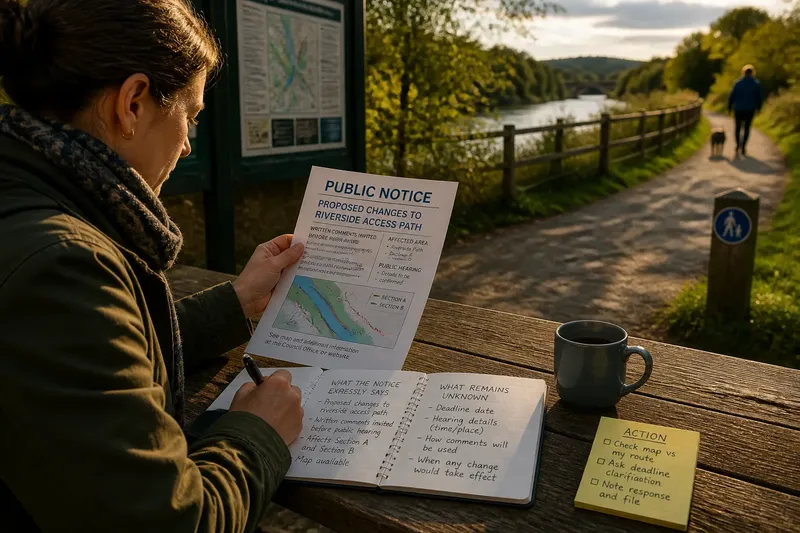
The common mistake with a public notice is to treat its heading as the whole message. A heading about a road closure, hearing or planning proposal can hide a practical detail that changes what you do next: the affected location, the status of the decision or the way to respond. Read the notice as a record with boundaries, not as a complete account of the issue.
What does the wording actually establish?
Read the notice once for its subject, then look closely at the verbs that describe what is happening. “Proposed”, “invites”, “will consider”, “approved” and “takes effect” describe different stages. A hearing announcement does not by itself establish that a proposal has been adopted.
Make two short notes: what the notice expressly says, and what remains unknown. For instance, “comments are invited before the hearing” is an explicit instruction; “the comments will change the outcome” is an assumption unless the notice says so.
Also note the issuing body, publication date and any file, application or meeting reference. Those details can help you distinguish the notice from a repost or summary and identify the record it concerns.
How can you tell whether the notice includes your situation?
Look for the limits that define who or what is covered: a named neighbourhood, road section, facility, property type or eligibility condition. If the notice points to a map, schedule or attached plan, use that material before deciding whether you fall within the stated boundary.
Keep relevance separate from participation. A proposed change may affect your daily route even if the notice limits a particular form or process to a defined group. Equally, an open invitation for comments may include people beyond those most directly affected.
If the wording leaves the boundary uncertain, write down the exact phrase and ask for clarification. Do not fill in a missing boundary from a nearby landmark or a general description.
Which dates change what you should do?
Copy each date into a note and label its purpose. A publication date, response deadline, meeting date and effective date are different things. If a time, time zone or delivery rule appears, copy that too rather than relying on memory.
- Publication date: If this tells you when the notice appeared, use it to identify the version you are reading; if no date is shown, check the issuing body’s record before relying on it.
- Response deadline: If comments or documents must arrive by a stated date, note the required route and plan around that date; if the wording is unclear, ask the stated contact promptly.
- Meeting or hearing date: If attendance or preparation may matter to you, record the time and location; if those details are missing, seek confirmation from the issuing body.
- Effective date: If the notice says an adopted change begins on a date, distinguish that from a proposal date; if no effective date is given, do not infer when a change starts.
- Delivery instruction: If the notice says a response must be received rather than sent by a date, follow the stated receipt condition; if it names no method, ask which route is accepted.
- Reminder point: If a relevant date is approaching, set a calendar reminder to reread the instructions; if no action is required from you, keep the notice for reference rather than creating a response task.
Use the earliest date that could affect your next action as your reminder point. A calendar entry is useful only if it includes what you need to check or submit.
What should you do when the notice leaves a gap?
Separate missing context from a contradiction. A short notice may not explain earlier discussions or alternatives, while conflicting dates or instructions may need prompt clarification. Look for a specifically named application, map, order, agenda or supporting paper rather than searching broadly for anything related.
When contacting the issuing body, quote the relevant wording and ask one focused question at a time. For example: “Does this deadline mean the response must arrive by that date, or be sent by then?” Keep a copy of the notice and any reply alongside your notes.
Say you receive an invented notice about a proposed change to a riverside access path. It says written comments are invited before a public hearing, names two path sections, and points to a map but gives no time for the deadline. You save the notice, check the map against the sections you use, and note that the hearing is a discussion rather than proof of approval. You then ask the issuing office whether comments must arrive by the deadline and record its answer; the resulting decision is to submit through the stated route if the clarified date leaves enough time, or to ask about another accepted method if it does not.
What can a notice tell you, and what remains open?
A public notice can set out a formal announcement, an invitation or an instruction. It may not explain the full background, every option considered or what will happen after a meeting. Treat the notice as evidence of what it states, not as a substitute for every related record.
Look for language that marks status: “proposed”, “under consideration”, “resolved” or “in force”. If the notice does not say what happened after an event, seek the relevant minutes, decision record or later notice. Where the legal effect of a formal notice could affect your rights or obligations, seek advice from a qualified professional.
Which questions do readers ask about a public notice?
How can I tell if a public notice applies to my property or area?
Compare the named boundary, property type or eligibility condition with the map or schedule cited in the notice. If the material does not settle the point, ask the issuing body to explain the exact boundary or condition.
Does a public hearing mean a decision has been made?
No: a hearing may be part of considering a proposal, but the notice’s wording determines what stage it describes. Look for a separate decision record or explicit statement that an action has been adopted or taken effect.
What if a public notice gives an unclear deadline?
Check the full wording for the date, time, delivery route and whether a response must be sent or received by then. If any part remains unclear, contact the named office promptly and retain the reply.
How do I find records referred to in a public notice?
Use its file number, application reference or meeting name when asking the issuing body for the specific map, agenda or decision record. A precise request is more likely to identify the document you need than a general request for background.
How can you make a quick reading record?
A compact note helps you return to the notice without relying on memory. Write down the source, the status it describes, the boundary, relevant dates and any unresolved question.
- Source: If the issuing body and reference are present, record them so you can retrieve the same notice; if either is absent, check the official record before acting.
- Status: If the notice says “proposed” or “under consideration”, treat the matter as not yet established; if it says a decision is adopted, look for its date and scope.
- Boundary: If a map or schedule defines the area, compare it with the place or property named in your concern; if no boundary is clear, ask for one rather than guessing.
- Dates: If a deadline or meeting date is stated, add it to your calendar with the required action; if only a publication date appears, do not mistake it for a response deadline.
- Next action: If the notice names a form, route or contact, follow that instruction; if it does not, ask the issuing body what action, if any, is available.
- Open question: If a missing detail could alter your response, write the question beside the relevant wording and seek clarification; if it would not change your next action, keep it as background rather than delaying.
For a public notice, the useful record is not a long interpretation: it is a clear distinction between what the document says, what it leaves unresolved and what you can decide to do next.